In this article
“Testosterone booster” is a marketing term, not a diagnosis or a guarantee. It is commonly used for supplements promoted to support the body’s testosterone production. Understanding the evidence starts with separating those products from lifestyle measures and prescribed hormone treatment.
This guide covers the claims, the human ingredient studies, and the questions worth asking before choosing a product.
What Is a Testosterone Booster?
Products and interventions discussed under this label fall into different categories:
- Dietary supplements — vitamins, minerals, and botanicals marketed for hormone support, with varying evidence.
- Lifestyle measures — sleep, activity, nutrition, and appropriate weight management that can address some reversible contributors to low testosterone.
- Prescription testosterone replacement therapy (TRT) — actual exogenous testosterone administered by a physician. Not a "booster" in the natural sense; it replaces what your body isn't making.
This guide focuses on supplements. Prescribed testosterone is a distinct medical treatment for appropriately diagnosed patients, not a fallback that requires trying boosters first.
Why Symptoms Deserve More Than a Marketing Label
Hormone levels are influenced by age, health, medicines, and other factors. A population trend does not establish that an individual needs a supplement. Relevant factors can include:
- Stress — its effects on health and hormone regulation vary.
- Sleep problems — including sleep restriction and possible sleep apnea.
- Physical activity and recovery — including whether training is supported by adequate food and rest.
- Obesity — associated with lower testosterone in some men through several mechanisms.
- Nutrition — particularly inadequate intake or confirmed deficiencies.
- Environmental endocrine disruptors — BPA, phthalates, and other compounds that interfere with hormone signaling.
These factors are reasons for assessment and appropriate changes, not proof that a testosterone booster is needed.
Proposed Mechanisms and Measured Outcomes
Supplement marketing often invokes these pathways. A mechanism still needs human outcome evidence:
- HPA-axis signaling — a proposed pathway rather than a verified effect of every adaptogen blend.
- Aromatase — changing an enzyme in a laboratory experiment does not establish safe hormone manipulation in users.
- Reproductive signaling — LH helps regulate testosterone production, but that does not validate a supplement that claims to support it.
- Nutritional status — correcting a deficiency differs from increasing intake when needs are already met.
- SHBG — a testosterone-binding protein whose interpretation belongs in the broader clinical picture.
Multiple proposed pathways do not establish that a combined product is more effective.
Ingredients Studied in Humans
Look for specific preparations and studies rather than a general “clinically proven” label:
- Ashwagandha — selected extracts have reported hormone changes in certain populations. The 2015 KSM-66 study also involved resistance training.
- Vitamin D — supplementation has not consistently increased testosterone in randomized trials; nutritional needs are a separate issue.
- Zinc — correct deficiency when present rather than assuming extra zinc will raise testosterone.
- Magnesium — essential for normal functions, but not an established treatment for testosterone deficiency.
- Boron — limited human evidence does not establish a reliable hormone or symptom benefit.
- Tongkat ali (Eurycoma longifolia) — has human data showing testosterone increases, particularly in stressed and aging men.
- Fenugreek — findings vary by extract and outcome.
- Purified shilajit — a trial in men aged 45–55 reported hormone changes after ninety days; product identity and purity matter.
This is not a required ingredient stack. Each product still needs to be evaluated on its actual contents and claims.
Lifestyle Factors Worth Addressing
Before any supplement, the lifestyle levers do the heavy lifting:
- Strength training — build strength and physical function; a brief hormone spike does not prove a lasting rise in resting testosterone.
- Sleep — protect a consistent schedule and get persistent sleep problems assessed.
- Stress management — use practical habits and support when stress affects daily life.
- Body composition — use an individualized plan when weight loss is appropriate, rather than a universal body-fat target.
- Diet — meet energy and nutrient needs with a sustainable pattern.
- Vitamin D status — meet needs without treating unprotected sun exposure as a testosterone protocol.
- Alcohol — consider its effects on sleep and health and discuss concerns with a clinician.
A supplement has not been shown to amplify every benefit of these habits.
Testosterone Boosters for Brain Function and Memory
Memory and focus deserve direct assessment. Testosterone acts in the brain, but a hormone decrease does not establish the cause of cognitive symptoms.
Researchers investigate several biological relationships:
- Hippocampal function — hormone signaling in a region involved in memory.
- Neurotransmitter signaling — interactions with systems involved in attention and motivation.
- BDNF — a protein involved in neuronal growth and survival.
- Brain structure and function — observed associations requiring careful interpretation.
Separate cognitive ingredient trials can inform a formula. They do not establish that dual-positioned products outperform other formulas or that increasing testosterone causes memory improvement.
How to Choose a Testosterone Booster
Useful evaluation criteria include:
- Study comparison — match the named ingredient, extract, dose, population, and outcome.
- Extract identity — different ashwagandha preparations are not automatically interchangeable.
- Ingredient transparency — full label disclosure, no hidden proprietary blends.
- Verifiable quality information — identity, purity, and manufacturing evidence rather than “clean” as a slogan.
- Brand credibility — real research backing, not just marketing claims.
- Claim fit — check direct evidence for the outcome you care about, including memory if that is a priority.
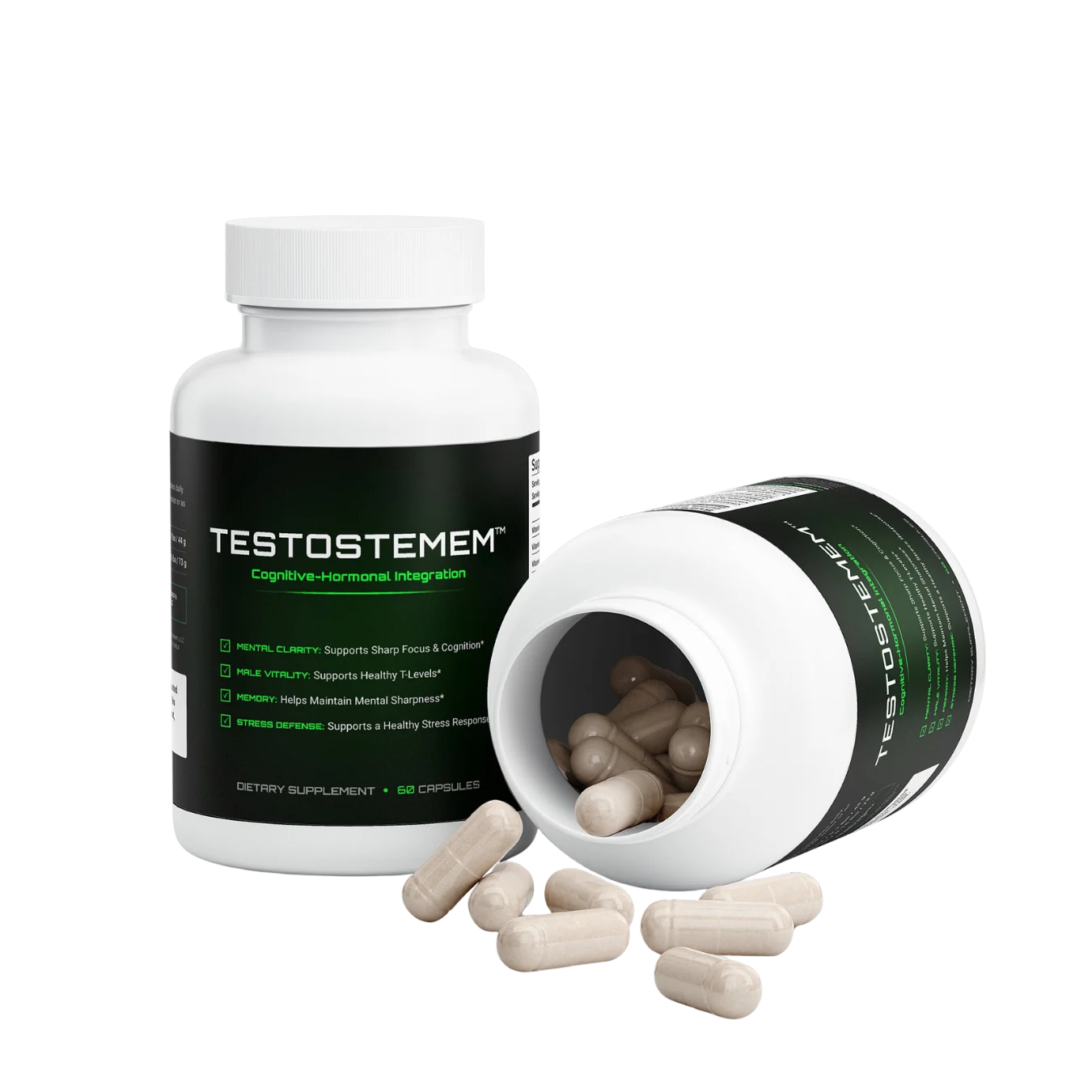
Testostemem combines natural testosterone support and memory support in one formula. Its ingredient amounts are disclosed and the separate ingredient studies are linked for inspection.
How Long Testosterone Boosters Take to Work
There is no universal response schedule:
- Stress — a study’s cortisol endpoint does not establish when an individual will feel a change.
- Energy and sleep — responses depend on the cause of the symptoms.
- Testosterone — repeat measurements need clinical context, and a supplement may not change them.
- Strength — training, nutrition, and recovery matter independently of hormones.
- Cognition — a hormone change is not a substitute for a measured cognitive outcome.
Do not postpone assessment of persistent symptoms for a three-to-six-month supplement program.
Testosterone Booster Side Effects and Safety
Natural products can have adverse effects and interactions. Ashwagandha’s long-term safety is not established, and rare liver injury has been reported. Vitamins and minerals can also cause harm when intake is excessive.
Cautions:
- Anyone on prescription medications should consult a doctor before starting any supplement, especially blood thinners, thyroid medications, or psychiatric medications.
- Men with suspected testosterone deficiency need appropriate assessment rather than self-treatment with boosters.
- Ask for transparent amounts and realistic claims. Dietary supplements are regulated differently from drugs; FDA does not approve them for safety and effectiveness before marketing.
Frequently Asked Questions About Testosterone Boosters
Do testosterone boosters actually work?
Some ingredients have shown hormone changes in specific trials. That does not establish predictable results from every finished blend.
What's the best testosterone booster?
No product is established as best for everyone. Compare direct evidence, ingredient identity, dose disclosure, quality, and suitability.
How long does a testosterone booster take to work?
Trial durations are not guaranteed response times. The featured KSM-66 studies assessed outcomes after eight weeks or sixty days.
Are testosterone boosters safe?
Safety depends on the ingredient, amount, product quality, medicines, and health conditions. Natural does not mean risk-free.
Do testosterone boosters work for cognitive function?
Some ingredients have direct cognitive studies. That does not establish that a testosterone booster improves cognition by raising testosterone.
KEEP READING
Sources & further reading.
- Endocrine Society: Hypogonadism in men
- Endocrine Society: Testosterone therapy clinical practice guideline
- NCCIH: Ashwagandha evidence and safety
- Wankhede et al. (2015): Ashwagandha with resistance training
- Choudhary et al. (2017): Ashwagandha and cognition pilot trial
- Resnick et al. (2017): Testosterone treatment and cognitive function
- Lerchbaum et al. (2019): Vitamin D trial in men with low testosterone
- NIH ODS: Zinc fact sheet
- NIH ODS: Magnesium fact sheet
- Pandit et al. (2016): Purified shilajit randomized trial
- FDA: Information for consumers on dietary supplements
TESTOSTERONE + MEMORY
Sharp mind.
Strong drive.
Testostemem brings eight ingredients together for testosterone and memory. Two capsules a day. That's it. No worries.
GET TESTOSTEMEM 60-day money-back guarantee on your first order.