In this article
Ashwagandha has a long history of use in Ayurveda. Human trials now give us something more specific to examine: results for particular extracts, populations, and outcomes, including testosterone and stress. The useful question is what those studies actually tested.
For men dealing with fatigue, brain fog, low libido, or the general sense that their drive isn't what it used to be, ashwagandha has emerged as one of the most-studied natural compounds for supporting healthy testosterone levels. This article breaks down what the research actually says, how it works, and what to look for if you're going to use it.
What Is Ashwagandha and Why Does It Affect Testosterone?
Ashwagandha (Withania somnifera) is an adaptogenic herb native to India, North Africa, and the Middle East. The Sanskrit name roughly translates to "smell of the horse" — referring to both its smell and the strength it was traditionally believed to confer. In Ayurvedic medicine, it's been classified as a Rasayana, a category of herbs used to promote longevity, vitality, and male reproductive health.
Withanolides are among ashwagandha’s active compounds. Researchers investigate effects on stress signaling and other pathways, but the mechanism behind a hormone change in a trial is not fully established.
Stress and hormone regulation interact. A simple chain of “lower cortisol, higher testosterone” has not been established as the explanation for every ashwagandha result.
What the Research Says About Ashwagandha and Testosterone
Several human studies have reported hormone changes. Their differences matter:
- A 2019 crossover trial in overweight men aged 40–70 used Shoden extract for an eight-week treatment period within a sixteen-week study. Testosterone increased 14.7% more and DHEA-S 18% more than during placebo; fatigue, vigor, and sexual well-being did not differ significantly between treatments.
- A 2015 trial in men with little resistance-training experience used 600 mg/day of KSM-66 alongside eight weeks of training. The extract group had larger gains in some strength measures and a greater average testosterone increase than placebo.
- Research in men with infertility has investigated reproductive hormones and sperm measures. Those results cannot be assumed to apply to healthy men buying a testosterone supplement.
- A 2012 trial in stressed adults reported a 27.9% cortisol reduction from baseline with KSM-66 versus 7.9% with placebo after sixty days. It did not establish that this cortisol change caused a testosterone increase.
These studies make the ingredient worth examining. They do not establish the same response for every extract, every man, or every finished blend.
What Researchers Are Investigating
Several possible pathways have been proposed:
- Stress signaling — investigated through measures such as cortisol and perceived stress.
- HPA-axis effects — a proposed mechanism, rather than a settled explanation for all outcomes.
- Sleep — some preparations have been studied for sleep outcomes; that is separate from proving a testosterone mechanism.
- Cellular effects — laboratory studies investigate responses to oxidative stress; human benefit cannot be inferred directly.
- Reproductive hormones — some studies examine hormone measures in specific fertility or age groups.
Lowering cortisol does not guarantee a testosterone increase. The 2019 trial found a testosterone difference without a significant between-treatment cortisol difference.
Ashwagandha Benefits for Men Beyond Testosterone
Other research has investigated these areas, with varying levels of evidence:
- Stress — some preparations have shown benefits; evidence for anxiety is less clear.
- Sleep — some studies report improvements with particular preparations.
- Cognition — a small pilot trial found selected test improvements in adults with mild cognitive impairment.
- Training — one trial reported strength and muscle gains alongside a resistance-training program.
- Metabolic measures — exploratory results do not establish a cardiovascular treatment.
- Reproductive outcomes — evidence from particular populations should not be generalized to sexual performance in all men.
Different outcomes require different evidence. A result in one study does not establish the entire list for a single product.
Compare the Extract, Dose, and Study
For the featured KSM-66 trial, the details were:
- 300 mg of KSM-66 root extract twice daily, totaling 600 mg per day.
- The named extract and its specifications were part of the intervention.
- Eight weeks of treatment alongside resistance training.
Different extracts are not automatically interchangeable. Follow a product’s directions and assess suitability rather than turning research doses into a universal protocol.
Ashwagandha and Cognitive Function: The Memory Connection
The 2017 cognition pilot used 300 mg of root extract twice daily in fifty adults with mild cognitive impairment. It reported improvements on selected memory and attention tests; it did not show that testosterone mediated those improvements.
Hormone and cognitive findings are separate reasons for interest. The evidence does not establish one as the hormonal cause and the other as a symptom resolved by the ingredient.
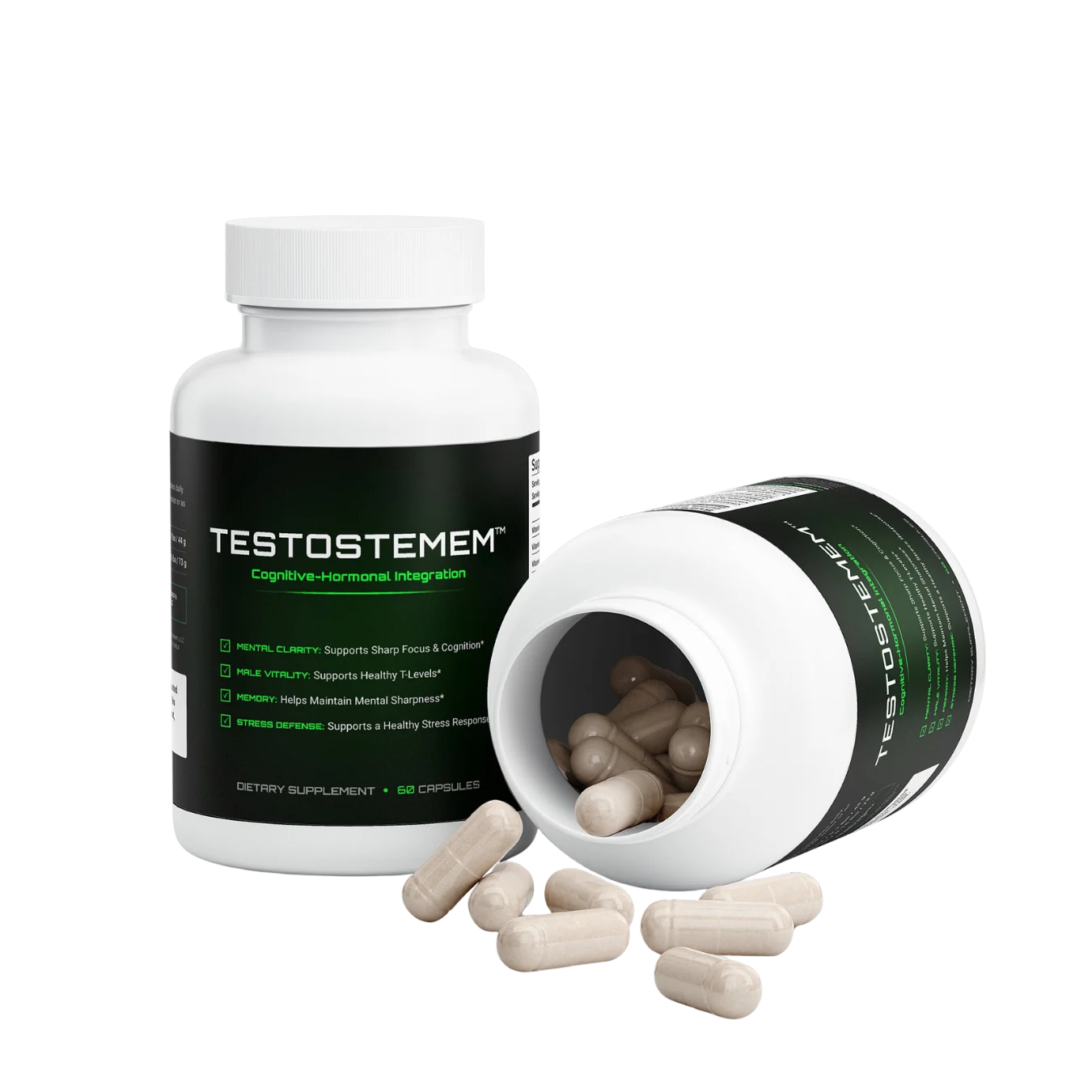
KSM-66 is a central ingredient in Testostemem, which brings natural testosterone support and memory support into one formula. The daily serving lists 600 mg; evidence for that ingredient does not prove that the full blend reproduces every study outcome.
Frequently Asked Questions About Ashwagandha and Testosterone
Does ashwagandha really increase testosterone?
Some trials of specific extracts report testosterone increases in selected groups. That does not establish a predictable increase for every man or supplement.
How long does it take ashwagandha to raise testosterone?
The featured studies assessed outcomes after eight weeks or sixty days. They do not establish a reliable week-by-week response for an individual.
Is ashwagandha safe to take long-term?
Long-term safety is not established. Ashwagandha can cause adverse effects and interactions, and rare liver injuries have been reported. Review suitability when you have a thyroid or autoimmune condition, prostate cancer, or take medicines.
Can ashwagandha help with brain fog and memory?
A small trial reported cognitive-test improvements in adults with mild cognitive impairment. It did not prove a testosterone-mediated effect or establish treatment of brain fog.
What's the best form of ashwagandha for testosterone?
Compare the exact preparation with the study supporting the claim. KSM-66, Sensoril, and Shoden have different specifications and are not interchangeable simply because each contains ashwagandha.
KEEP READING
Sources & further reading.
TESTOSTERONE + MEMORY
Sharp mind.
Strong drive.
Testostemem brings eight ingredients together for testosterone and memory. Two capsules a day. That's it. No worries.
GET TESTOSTEMEM 60-day money-back guarantee on your first order.