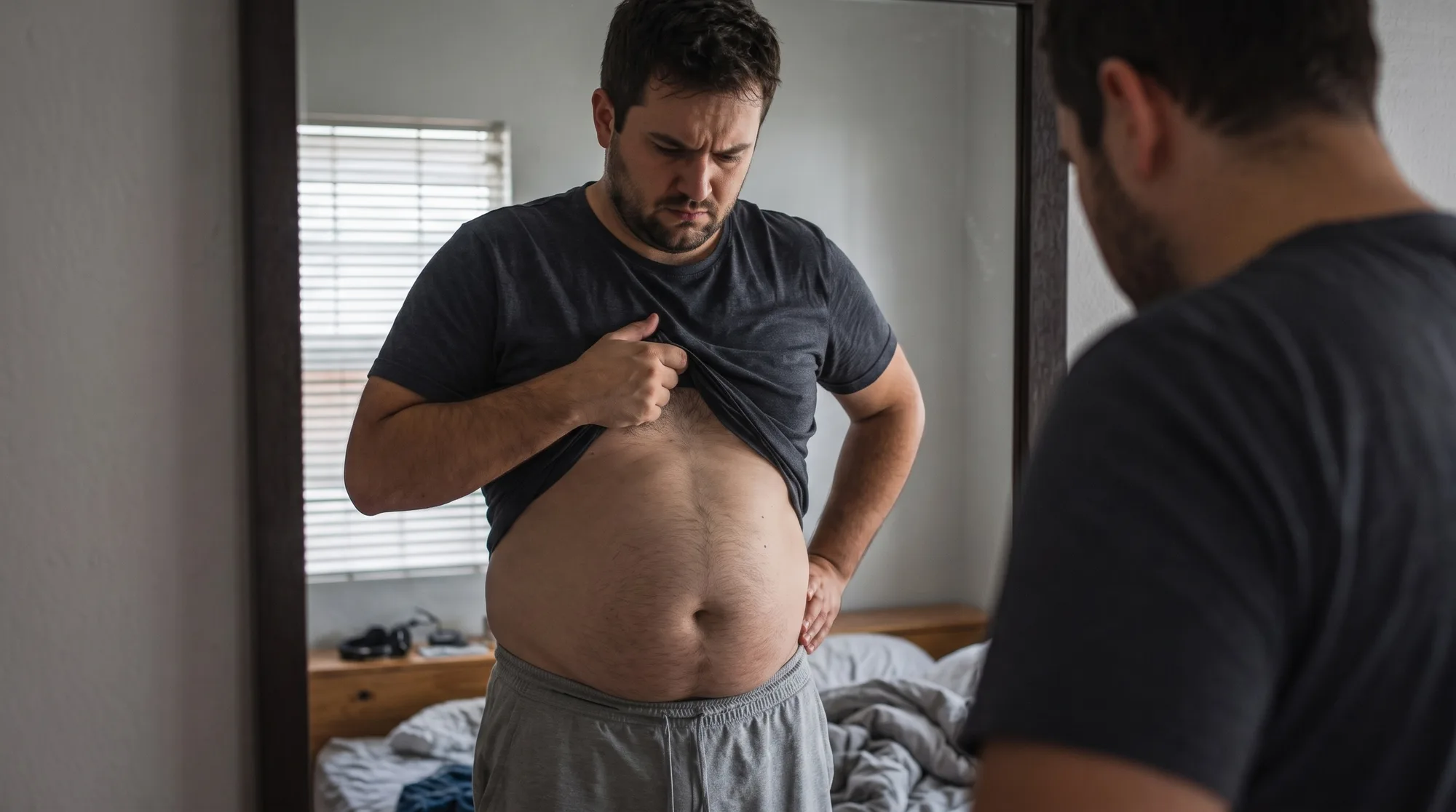
Low testosterone and belly fat feed each other in a vicious cycle — low testosterone makes your body store more fat, and that stored fat lowers your testosterone even further. This is why so many men over 35 struggle to lose the gut no matter how hard they train: the underlying hormonal problem keeps driving fat storage. The good news is that the cycle runs both ways. Losing the fat raises testosterone, and raising testosterone helps burn the fat. This article explains the testosterone-belly fat connection and exactly how to break the cycle.
If you've been fighting stubborn belly fat that won't budge despite diet and exercise, the real problem may be hormonal — and understanding the cycle is the key to reversing it. Here's how testosterone and belly fat are connected.
Why Does Low Testosterone Cause Belly Fat?
Low testosterone causes belly fat because testosterone regulates how your body stores and burns fat. When testosterone drops, the body shifts toward storing fat — particularly visceral fat, the dangerous fat that accumulates around the abdomen and organs. Testosterone normally supports muscle maintenance and fat metabolism, so when it falls, muscle declines and fat accumulates.
The mechanisms behind low-testosterone fat storage:
- Reduced fat metabolism. Testosterone helps regulate the enzymes and pathways that burn fat. Lower testosterone means less efficient fat burning.
- Muscle loss. Testosterone maintains muscle mass, and muscle is metabolically active tissue that burns calories. Losing muscle lowers your metabolic rate, making fat gain easier.
- Increased fat storage signaling. Low testosterone shifts the body toward storing energy as fat, especially in the abdominal region.
- Insulin resistance. Low testosterone is associated with insulin resistance, which promotes fat storage and makes fat loss harder.
The result is that a man with low testosterone stores fat more easily and burns it less efficiently — and the fat concentrates in the belly.
What Is the Testosterone-Belly Fat Cycle?
The testosterone-belly fat cycle is a self-reinforcing loop where low testosterone causes belly fat, and belly fat further lowers testosterone. This is sometimes called the hypogonadal-obesity cycle, and it's one of the reasons belly fat is so stubborn in men with low testosterone.
Here's how the cycle works:
- Low testosterone promotes fat storage, especially visceral belly fat
- Belly fat contains high levels of the enzyme aromatase
- Aromatase converts testosterone into estrogen
- More belly fat means more aromatase, which means more testosterone converted to estrogen
- Lower testosterone promotes even more fat storage
- The cycle repeats and accelerates
This is the trap: the more belly fat you carry, the more your testosterone gets converted to estrogen, and the lower your testosterone drops — which drives more fat storage. Breaking this cycle requires attacking it from both sides at once.
How Does Belly Fat Lower Testosterone?
Belly fat lowers testosterone primarily through aromatase, the enzyme in fat tissue that converts testosterone into estrogen. Visceral belly fat is particularly active in this conversion, which means the more abdominal fat a man carries, the more of his testosterone gets converted away.
Belly fat suppresses testosterone through:
- Aromatase activity. Fat tissue, especially visceral fat, is rich in aromatase, which converts testosterone to estrogen. This directly reduces testosterone levels.
- Inflammation. Visceral fat produces inflammatory compounds that suppress testosterone production at the testes.
- Insulin resistance. Belly fat drives insulin resistance, which further impairs testosterone production.
- Leptin dysregulation. Excess fat disrupts leptin signaling, which affects the hormonal signals that support testosterone.
This is why belly fat isn't just a cosmetic problem — it's an active endocrine disruptor that suppresses the hormone men need to burn it off.
What Are the Signs Your Belly Fat Is Hormonal?
Hormonal belly fat — belly fat driven by low testosterone — tends to show up alongside other low-testosterone symptoms, which distinguishes it from simple overeating. The signature:
- Belly fat that persists despite diet and exercise
- Reduced libido and weaker morning erections
- Persistent fatigue and low energy
- Brain fog and difficulty concentrating
- Loss of muscle mass and strength
- Low motivation and drive
- Mood flattening or irritability
If your belly fat is accompanied by several of these symptoms, low testosterone is likely part of the equation — and addressing the hormonal side is what makes the fat loss possible.
How Do You Break the Testosterone-Belly Fat Cycle?
Breaking the testosterone-belly fat cycle requires attacking it from both directions: losing the fat to reduce aromatase, and raising testosterone to improve fat metabolism. Because the cycle is self-reinforcing, progress on either side helps the other.
The protocol:
Prioritize strength training. Building muscle raises testosterone, increases metabolic rate, and improves insulin sensitivity — hitting multiple points in the cycle at once. Heavy compound lifts are the most effective.
Add high-intensity intervals. HIIT is particularly effective at reducing visceral belly fat and supporting testosterone, more so than steady-state cardio alone.
Fix your diet. Prioritize protein, healthy fats, and whole foods. Reduce refined carbs and sugar, which drive insulin resistance and fat storage. Getting into a moderate caloric deficit reduces the fat that's converting testosterone to estrogen.
Manage cortisol. Chronic stress raises cortisol, which independently drives visceral fat storage and suppresses testosterone. Managing stress directly attacks the belly fat cycle.
Fix your sleep. Poor sleep raises cortisol, lowers testosterone, and increases fat storage. Quality sleep supports the entire process.
Support with the right compounds. Ashwagandha lowers cortisol (which drives belly fat) and supports testosterone, addressing the hormonal side of the cycle. Clinical trials show it reduces cortisol by 20–30% and supports testosterone and body composition in trained men.
Most men who attack the cycle from both sides see the belly fat start to shift within 8–16 weeks, as testosterone recovers and fat metabolism improves.
When Should You Get Your Testosterone Tested?
Get a comprehensive testosterone panel if your belly fat persists despite consistent diet and exercise, especially if it's accompanied by other low-testosterone symptoms. The panel should include total testosterone, free testosterone, SHBG, LH, FSH, and estradiol — the estradiol measurement is particularly relevant here, since it reveals how much testosterone is being converted to estrogen by belly fat.
Most men can break the cycle through consistent lifestyle intervention and targeted support. But if testosterone is clinically low or the belly fat isn't responding, a doctor can help determine whether additional support is needed.
Attacking Belly Fat at the Hormonal Root
The men who finally lose stubborn belly fat are the ones who stop treating it as purely a calorie problem and start treating it as the hormonal cycle it actually is. Diet and exercise matter, but if low testosterone and high cortisol are driving the fat storage, addressing the hormonal side is what unlocks the results.
This is the framework behind Testostemem — built around the testosterone-cortisol-cognition axis that drives fat storage, low drive, and brain fog in men over 35. The formula combines clinically dosed ashwagandha — which lowers the cortisol that drives visceral fat and supports the testosterone that burns it — with other compounds that address the hormonal substrate underneath stubborn belly fat. For men stuck in the low-T, high-belly-fat cycle, addressing the hormonal root is what makes the difference.
Frequently Asked Questions About Testosterone and Belly Fat
Does low testosterone cause belly fat?
Yes. Low testosterone shifts the body toward storing fat, especially visceral belly fat, while reducing the muscle mass that supports metabolism. Low testosterone also drives insulin resistance, which promotes further fat storage.
Does belly fat lower testosterone?
Yes. Belly fat, particularly visceral fat, contains high levels of aromatase, the enzyme that converts testosterone to estrogen. More belly fat means more testosterone converted away, creating a self-reinforcing cycle of low testosterone and increasing fat.
How do I lose belly fat caused by low testosterone?
Attack the cycle from both sides: build muscle through strength training to raise testosterone, reduce fat through diet and HIIT to lower aromatase, manage cortisol and sleep, and support testosterone with targeted compounds. Progress on either side helps the other.
Why can't I lose belly fat even with diet and exercise?
If low testosterone is driving the fat storage, diet and exercise alone may not be enough because the hormonal cycle keeps working against you. The belly fat converts testosterone to estrogen, lowering the hormone you need to burn fat. Addressing the hormonal side is often the missing piece.
Can ashwagandha help with belly fat?
Ashwagandha addresses the hormonal side of belly fat by lowering cortisol (which drives visceral fat storage) and supporting testosterone (which improves fat metabolism). Clinical trials show it reduces cortisol by 20–30% and supports body composition, making it useful for the low-T, high-belly-fat cycle.